
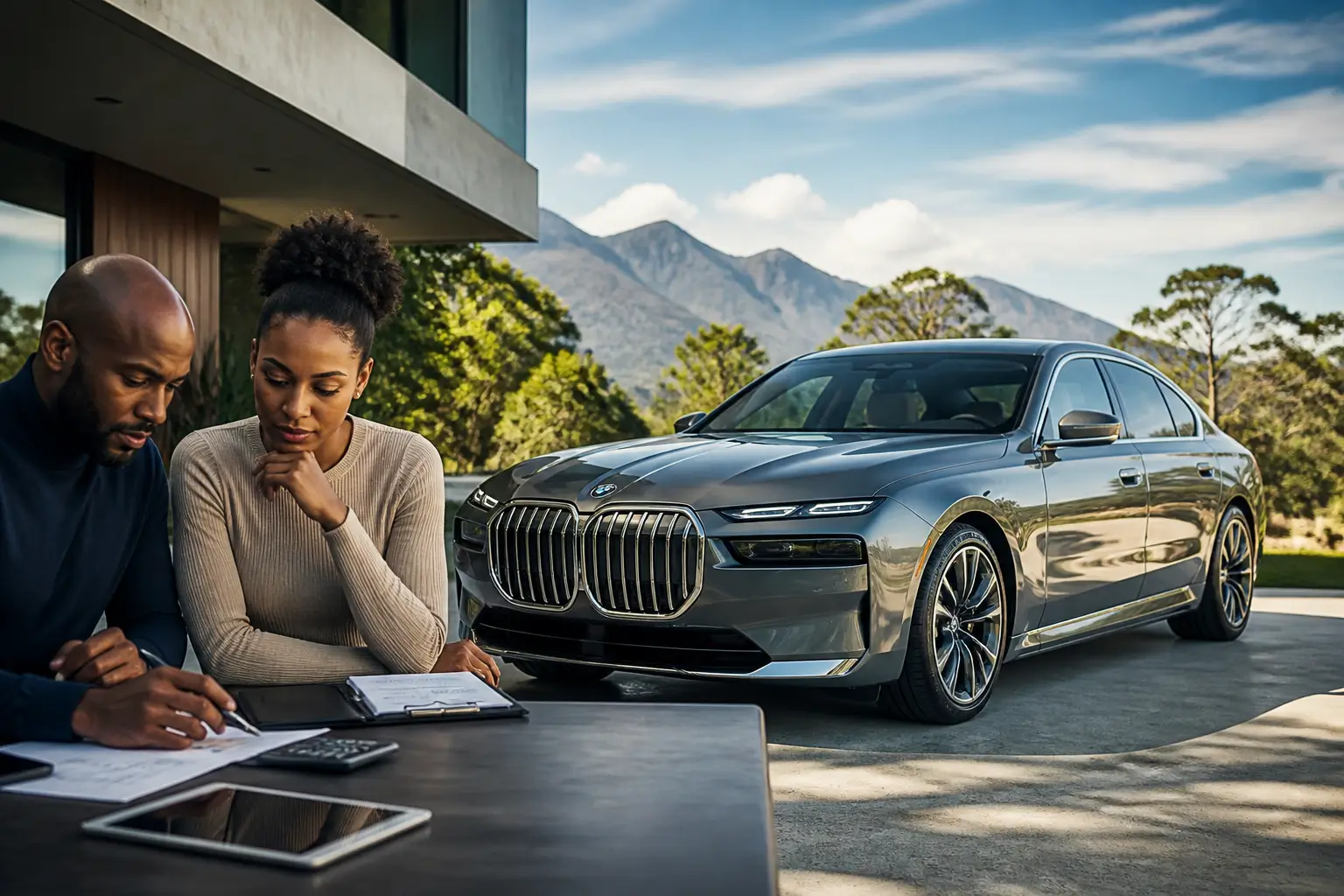
Understanding vehicle finance South Africa: your options for high-end cars
If you are planning to finance a luxury vehicle in South Africa, the first step is understanding the vehicle finance South Africa landscape. Whether you are eyeing a premium sedan like the new BMW 7 Series — set to arrive locally in Q4 2026 with pricing from R2.3 million to R3.1 million — or any other high-value car, knowing your finance routes can save you thousands of rand and years of unnecessary debt.
In our experience helping South Africans navigate credit and borrowing decisions, we see the same question come up again and again: should you finance through a bank, a dealership, or consider a personal loan? Each route has trade-offs, and the right choice depends on your credit profile, deposit amount and how much flexibility you need.
Let's walk through the core vehicle finance options available in South Africa, the real costs involved, and how a luxury launch like the BMW 7 Series illustrates the importance of careful planning.
Three main routes for vehicle finance in South Africa
South African buyers typically choose between three finance structures. Each has different approval criteria, interest rates and repayment terms.
- Finance type: Bank vehicle finance — How it works: A secured loan from your bank, with the car as collateral. The bank owns the vehicle until final payment. — Typical interest rate range: Prime + 2% to prime + 5% (roughly 9.5%–13.5% as of 2026) — Best for: Buyers with good credit scores and stable income
- Finance type: Dealership finance — How it works: Finance arranged through the car dealer, often via a partnership with a finance house. May include promotional rates or balloon payments. — Typical interest rate range: Prime + 3% to prime + 7%, sometimes higher depending on promotion — Best for: Buyers who prefer one-stop shopping and may benefit from manufacturer specials
- Finance type: Personal loan — How it works: An unsecured loan you can use for any purpose, including buying a car outright. No collateral required. — Typical interest rate range: Prime + 5% to prime + 12% or more, depending on credit — Best for: Buyers who want to own the car immediately or have poor credit history (higher risk for lender)
The interest rate you actually qualify for depends heavily on your credit score, employment history and existing debt. A buyer with an excellent credit record might secure bank finance closer to prime, while someone with past defaults could face rates at the upper end or even be declined.
What about balloon payments?
Many dealership finance deals include a balloon payment — a lump sum due at the end of the loan term, sometimes 20% to 35% of the original purchase price. This lowers your monthly instalment but leaves you with a large bill at the end. You will need to either pay it in cash, refinance it, or trade in the car. Balloons can be useful if you plan to upgrade regularly, but they are risky if your financial situation changes.
How your credit score shapes your vehicle finance deal
Your credit score is one of the biggest levers in vehicle finance. Lenders use it to decide whether to approve you, what interest rate to charge, and how much deposit to require.
In South Africa, credit scores generally range from around 300 to 850 (depending on the bureau). A score above 670 is considered good, and above 750 is excellent. Below 600, many traditional lenders will either decline you or offer terms with much higher rates.
A single percentage point difference in your interest rate can mean tens of thousands of rand over a five-year vehicle finance term. It pays to check your credit report before you apply.
If your score is lower than you would like, consider taking a few months to improve it before applying. Pay down existing debt, correct any errors on your credit report, and avoid applying for new credit in the lead-up to your car purchase. Each rejected application can lower your score further.
Deposits, terms and the true cost of financing a luxury car
Let's use the upcoming BMW 7 Series launch as a case study. Say the entry-level model lands at R2.3 million. Most lenders will require a deposit of at least 10% to 20% for a vehicle in this price bracket — that is R230,000 to R460,000 upfront.
Assume you put down R460,000 and finance the remaining R1.84 million over 60 months at an interest rate of 11% per annum (a realistic mid-range rate for a buyer with good credit). Your monthly instalment would be approximately R40,200, excluding insurance and maintenance.
Over the full term, you would pay around R2.41 million in total — meaning roughly R570,000 in interest alone. That is the real cost of borrowing, and it highlights why comparing rates and terms matters so much.
Shorter terms mean less interest
If you can afford higher monthly payments, a shorter loan term will save you money. Financing the same R1.84 million over 36 months instead of 60 would push the instalment to around R60,400 per month, but you would pay only about R330,000 in interest — a saving of R240,000.
The trade-off is cash flow. A higher instalment leaves less room in your monthly budget for emergencies, school fees or other expenses. You need to balance total cost against monthly affordability.
Why luxury car prices are higher in South Africa
Import duties, VAT and exchange-rate fluctuations all push up the landed cost of foreign vehicles. According to the South African Revenue Service, passenger vehicles can attract import duty of up to 25%, plus 15% VAT on the duty-inclusive value. For a car like the BMW 7 Series, which is manufactured overseas, these costs are baked into the showroom price.
That is one reason a vehicle that costs €100,000 in Europe might arrive in South Africa priced closer to R2.5 million once all taxes, shipping, dealer margins and compliance costs are included. As a buyer, you cannot avoid these costs, but you can control how much interest you pay on top of them by choosing your finance carefully.
Vehicle finance vs. personal loans: which makes sense?
For most buyers, traditional vehicle finance (bank or dealership) is cheaper than a personal loan because the car itself is used as security. That lowers the lender's risk and usually results in a lower interest rate.
However, a personal loan can make sense in certain situations:
- You want to own the car outright from day one, with no lien registered against it
- You are buying a second-hand car privately and the seller will not wait for bank finance approval
- Your credit record is impaired and traditional vehicle finance is not available
The downside is higher interest and, often, a shorter repayment term. If you are considering this route, make sure the monthly repayment is genuinely affordable — unsecured debt can become a trap if your income drops.
You can explore responsible personal loan options with Spring Loans, but always compare the total cost against secured vehicle finance first.
What the BMW 7 Series launch teaches us about affordability
The new BMW 7 Series arrives in South Africa with luxury features including leather and crystal-glass trim, an 8K rear entertainment screen, plug-in hybrid and fully electric powertrains, and AI-assisted parking. It is a technological showcase and a comfortable long-distance cruiser.
But for our purposes, the most important feature is the price tag. At R2.3 million to R3.1 million, this is a car aimed at a very narrow slice of the market — and it is a reminder that even buyers with high incomes need to think carefully about repayment discipline.
A R40,000-per-month car payment might be manageable on paper if you earn R200,000 a month, but what happens if you also have a bond, school fees, medical aid and existing personal loans? The margin for error shrinks quickly.
Practical steps before you sign any vehicle finance agreement
Whether you are financing a luxury sedan or a family hatchback, the same principles apply. Here is what we recommend:
- Check your credit score at least three months before you plan to buy, and correct any errors.
- Save a larger deposit if possible — every extra R10,000 upfront reduces your interest bill.
- Get quotes from at least three lenders — your bank, the dealership finance partner, and an independent finance broker.
- Compare total cost, not just monthly instalment — a lower monthly payment with a balloon or longer term can cost you more overall.
- Factor in running costs — insurance on a R2.3 million car can easily exceed R5,000 per month, plus fuel, tyres and maintenance.
- Stress-test your budget — can you still afford the repayment if your income drops by 20% or your expenses rise?
If the numbers do not add up comfortably, it is better to choose a less expensive vehicle or wait until your financial position improves. A car should never stretch your budget to breaking point.
Frequently asked questions
What deposit do I need for vehicle finance in South Africa?
Most lenders require a deposit of 10% to 20% of the purchase price, though some promotional deals may offer lower or zero-deposit finance. A larger deposit reduces the amount you borrow and can help you qualify for a better interest rate.
Can I get vehicle finance with bad credit?
It is possible, but you will likely face higher interest rates, a larger deposit requirement, or both. Some specialist lenders cater to buyers with impaired credit, but the total cost of borrowing will be significantly higher. Consider improving your credit score before applying if you have time.
Is dealership finance more expensive than bank finance?
Not always. Dealerships sometimes offer manufacturer-subsidised rates or promotional deals that can beat standard bank rates. However, dealership finance often includes balloon payments or other conditions, so compare the total repayment amount and read the fine print carefully.
How does a balloon payment work?
A balloon payment is a lump sum due at the end of your finance term, typically 20% to 35% of the original vehicle price. It lowers your monthly instalment but leaves you with a large final bill. You can pay it in cash, refinance it, or trade in the car. Balloons suit buyers who plan to upgrade regularly but can be risky if your circumstances change.
What interest rate can I expect on vehicle finance in South Africa?
As of 2026, most buyers with good credit can expect rates between prime + 2% and prime + 5%, roughly 9.5% to 13.5% per annum. Buyers with weaker credit profiles may pay prime + 7% or more. Always shop around and negotiate — even a 0.5% reduction can save you thousands over the life of the loan.
This article is for general informational purposes only and is not financial advice. Spring Loans is a registered South African credit provider — please speak to a qualified financial adviser or registered credit provider before making borrowing decisions.
Ready to apply?
Spring Loans is a registered South African credit provider. Visit www.springloans.co.za to check your eligibility and apply online.